We are living through an unusual moment in history. Artificial intelligence is changing how people work and create. Digital money is changing how value moves. Automation and robotics are expanding what machines can do. Individuals are gaining capabilities that once belonged only to large corporations. Careers are becoming less permanent, global economic power is shifting, energy is becoming increasingly important to the intelligence economy, and algorithms are determining more of what each of us sees.
These developments are usually discussed separately. I don’t believe they are separate.
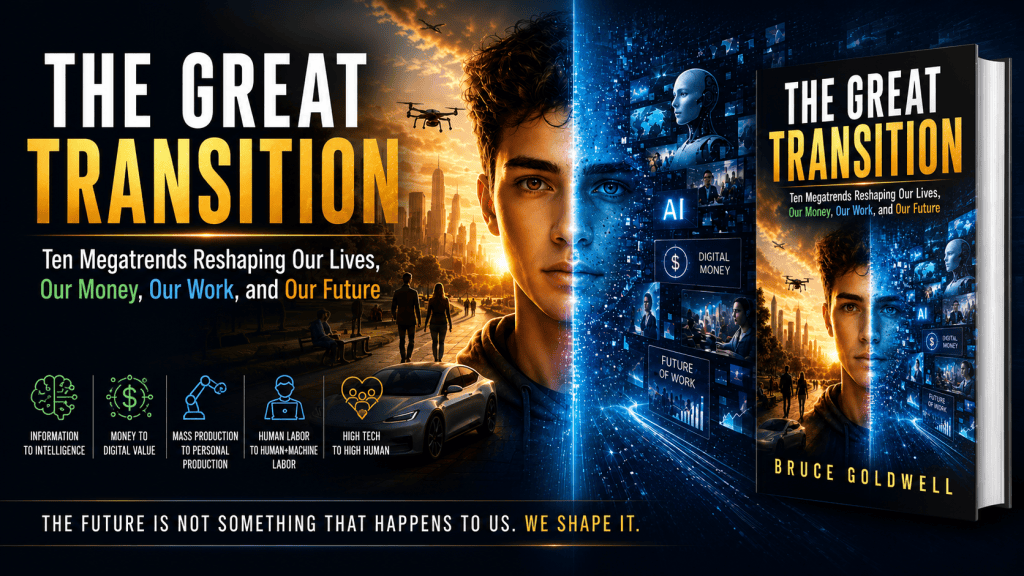
I believe we are living through a great transition—a period when several fundamental systems are changing at approximately the same time. That is the idea behind my book, The Great Transition: Ten Megatrends Reshaping Our Lives, Our Money, Our Work, and Our Future.
The purpose of the book isn’t to predict exactly what the world will look like in 2040. It is to identify changes already underway, determine where they appear to be heading, and ask what those changes could mean for ordinary people.
We Have Lived Through Great Transitions Before
As a Baby Boomer, I remember a world that would seem remarkably different to someone growing up today.
Televisions were black and white and operated with vacuum tubes. Telephones hung on walls, and some households shared party lines. A telephone wasn’t something you carried with you—you went to where the telephone was.
There was no Internet, Google, smartphone, GPS, social media, streaming video, or personal computer sitting on every desk.
If you wanted information, you might go to a library, open an encyclopedia, ask someone who knew the answer, or simply live without knowing.
None of this seemed primitive at the time. It was simply the world we knew.
Then the world changed.
And it kept changing.
That experience provides an important perspective on what is happening now. Technologies that initially seem extraordinary can eventually become so ordinary that the next generation has difficulty imagining life without them.
Today’s impossible can become tomorrow’s ordinary.
The mistake is assuming the world we know today is somehow the finished version.
It isn’t.
1. From Information to Intelligence
The Internet gave billions of people access to information. Artificial intelligence is beginning to give people access to something different: usable intelligence on demand.
Instead of simply searching for documents and websites, people can ask AI systems to analyze information, summarize it, compare alternatives, explain difficult subjects, write, create images, develop software, organize projects, and increasingly perform sequences of actions.
This represents something much larger than a better search engine.
AI assistants can already function as tutors, researchers, programmers, designers, analysts, and creative collaborators. AI agents point toward systems capable of performing increasingly complex tasks with less direct human involvement.
That raises an extraordinary economic question: What happens when capabilities that once required expensive expertise become available to almost everyone?
Expertise doesn’t necessarily become worthless. Instead, scarcity moves.
When information becomes abundant, attention becomes scarce. When answers become abundant, good questions become more valuable. When machines can produce convincing responses, verification becomes more important.
Human judgment may therefore become more valuable, not less.
2. From Human Labor to Human + Machine Labor
For centuries, machines primarily multiplied human muscle. The next generation of machines increasingly multiplies human thought.
AI can perform portions of knowledge work while robots and autonomous systems expand further into manufacturing, transportation, logistics, agriculture, and other physical activities.
The popular question is often: Will AI take our jobs?
That may be too simplistic.
A more useful question is: Which parts of our jobs will machines perform, and what becomes more valuable for humans to do?
History suggests that occupations do not always disappear when new technology arrives. Some disappear, some change dramatically, and entirely new occupations emerge.
The future may increasingly belong to people who learn how to work with intelligent machines rather than trying to compete against them.
3. From Money to Digital Value
One of the most important transitions may also be one of the least understood.
Money has already been becoming digital for decades. Direct deposit, credit cards, online banking, electronic trading, and payment apps changed how we interact with money without eliminating national currencies.
The next transition goes deeper.
Financial systems are beginning to experiment with digitizing and programming not only money, but securities, contracts, ownership rights, and other representations of value.
That includes blockchain settlement, stablecoins, tokenized assets, smart contracts, and digital financial networks. Bitcoin demonstrated that a scarce digital asset could exist without a conventional central issuer. Networks such as the XRP Ledger illustrate another part of the transformation: using digital networks to move and settle value rapidly. Stablecoins demonstrate how familiar national currencies can exist as tokens on blockchain infrastructure.
Tokenization potentially extends the concept further to bonds, funds, real estate, securities, and other assets.
For that reason, I don’t see the megatrend simply as cryptocurrency replacing money.
The larger transition is this:
Value itself is becoming increasingly digital, networked, and programmable.
The important question is what happens when moving value begins to resemble moving information.
4. From Mass Production to Personal Production
The twentieth-century economy rewarded scale. Reaching large markets often required factories, employees, publishing companies, television studios, distribution networks, or substantial amounts of capital.
Many of those barriers are falling.
An author can independently publish a book worldwide. A musician can record and distribute music without a traditional record company. A creator can reach millions without owning a television network. Entrepreneurs can sell internationally almost from the moment they open their businesses.
Artificial intelligence pushes this trend further by lowering the cost of writing, design, programming, research, marketing, and administration.
We may be entering the age of the one-person enterprise and the micro-multinational—where an individual equipped with AI, automation, and global distribution can accomplish work that once required an entire department.
5. From Institutions to Individuals
Publishers once determined which authors reached national audiences. Television networks determined who could broadcast to millions. Record companies controlled much of music distribution. Universities controlled access to much advanced instruction, while banks controlled access to important parts of financial infrastructure.
Those institutions aren’t disappearing, nor should we assume they will.
But their monopoly on access is weakening.
People can publish directly, teach directly, build audiences directly, raise money from communities, sell globally, and access sophisticated digital tools without receiving permission from many of the traditional gatekeepers.
This creates tremendous opportunity, but it creates another problem.
When almost anyone can publish, create, teach, or build an audience, access itself is no longer enough. Trust becomes the new gatekeeper.
6. From Career to Reinvention
For generations, the basic life map was relatively straightforward: education, career, retirement.
That map is weakening.
People are living longer. Technology changes faster. Skills can become obsolete. Online education makes retraining easier. Remote work removes some geographic barriers, while AI can accelerate the process of learning new skills.
The result may be a lifetime containing several professional identities instead of one.
I understand this personally. My own life has included military service, computer programming, drafting, carpentry, songwriting, entrepreneurship, publishing, and writing.
At one time, having interests across many different fields could be dismissed as lacking focus. In an economy where knowledge from different fields can increasingly be combined, the opposite may become true.
The polymath may be making a comeback.
One of the most important career skills of the future could therefore be the ability to reinvent yourself.
7. From Globalization to a Multipolar World
Globalization isn’t simply disappearing. It is changing shape.
The United States remains an enormous economic and technological power, while China, India, and emerging economies are altering the distribution of global economic activity.
At the same time, countries are becoming more concerned about semiconductor manufacturing, critical minerals, energy, food security, industrial capacity, and resilient supply chains.
The result may be a form of globalization that is more regional, strategic, and competitive than the version that followed the Cold War.
Instead of a world organized around one dominant economic center, we may increasingly operate in a multipolar economic world.
8. From Energy Consumption to Energy Abundance
Artificial intelligence doesn’t run on magic.
Neither do robots, factories, electric transportation systems, digital financial networks, or desalination plants. They all require energy.
The intelligence age could require enormous amounts of reliable electricity, making energy infrastructure inseparable from discussions about technological and economic development.
Advanced nuclear power, solar and storage, geothermal energy, natural gas, grid modernization, and perhaps eventually fusion are therefore about more than environmental policy. They are also questions of economic competitiveness, technological capability, national security, and prosperity.
Cheap, reliable, abundant energy expands what civilization can afford to do.
9. From Mass Media to Personalized Reality
There was once a remarkable cultural experience that younger people may find difficult to imagine: millions of Americans regularly watched the same television programs and the same evening news broadcasts.
That shared information environment has fractured.
Algorithms now determine much of what we encounter online. Two neighbors can open their phones and receive radically different pictures of what is happening in the world.
Artificial intelligence could push personalization much further through personalized entertainment, advertising, AI companions, synthetic voices, synthetic video, AI-generated summaries, and eventually highly individualized media environments.
This creates one of the most serious challenges of the transition.
Personalization is not the same thing as truth.
When convincing content becomes inexpensive to manufacture, determining where information came from and whether it is trustworthy becomes increasingly important.
10. From High Tech to High Human
This may be the most hopeful of the ten megatrends.
The more technology surrounds us, the more valuable genuinely human experiences may become.
If machines can create unlimited images, human-created art acquires a different meaning. If an AI can converse endlessly, a real friend who chooses to spend an afternoon with you becomes more valuable. If almost anything can be simulated, authentic experiences become special.
We may therefore see a powerful countertrend developing alongside accelerating technology:
High Tech → High Human.
Authenticity, relationships, community, craftsmanship, empathy, meaning, purpose, and trust may become more—not less—valuable in a world filled with intelligent machines.
Technology may ultimately force us to think more deeply about what makes humanity valuable.
The Master Trend: From Knowledge to Judgment
There is another transition connecting nearly everything discussed above.
For thousands of years, knowledge was scarce. Books were scarce. Libraries were valuable because information was difficult to obtain. Experts were valuable partly because specialized knowledge took years to acquire.
The Internet began dismantling information scarcity. Artificial intelligence accelerates the process dramatically.
The challenge may soon be less about obtaining an answer and more about deciding which answer matters.
When information becomes abundant, attention becomes scarce. When content becomes unlimited, credibility becomes scarce. When synthetic media becomes convincing, authenticity becomes scarce. When machines can generate thousands of possibilities, judgment determines which possibility should become reality.
That may make human judgment one of the premium skills of the intelligence age.
The Future Is Not Something That Happens to Us
Megatrends are powerful, but they are not destiny.
Artificial intelligence can empower individuals or concentrate power. Digital money can increase financial freedom or financial control. Automation can create abundance or deepen inequality. Personalized media can educate people or isolate them inside information bubbles. Longer lives can produce remarkable second and third acts—or longer periods without purpose.
Technology creates possibilities. People decide what to do with them.
That is why I wrote The Great Transition.
The goal isn’t to tell readers exactly what the world will look like in 2040. It isn’t to tell people to fear technology, nor is it to promise that every new invention will create a technological utopia.
The goal is to recognize the direction of change early enough that we can understand it, prepare for it, adapt to it, and participate in determining what comes next.
We aren’t waiting for the future. We are already living between two ages.
The Great Transition: Ten Megatrends Reshaping Our Lives, Our Money, Our Work, and Our Future by Bruce Goldwell is available now on Amazon.
View The Great Transition on Amazon
You can also explore the book, the ten megatrends, AI and intelligence, digital money, and additional resources at the official book website:
Explore The Great Transition website
Suggested WordPress excerpt:
Ten megatrends are converging at once—from artificial intelligence and digital money to career reinvention, energy, personalized media, and human judgment. Bruce Goldwell explores why we may already be living between two ages.
Suggested SEO title:
The Great Transition: 10 Megatrends Reshaping Our Future
Suggested meta description:
Explore 10 megatrends reshaping AI, work, digital money, careers, energy, media, and society—and what they could mean for our future.
Suggested WordPress tags:
Artificial Intelligence, Megatrends, Future of Work, Digital Money, XRP, Automation, Future Trends, Technology, Career Reinvention, Bruce Goldwell


Leave a Reply