
Disagreement has become one of the defining features of modern Christianity.
Believers still read scripture. They still pray. They still speak about faith with sincerity. Yet certainty feels increasingly fragile, and agreement often seems impossible. For many, this has created frustration or fatigue. For others, silence. For some, a quiet step away from conversations that feel louder than they are honest.
But what if disagreement is not the failure we assume it is?
Christianity has never been a tradition of uniform belief. From its earliest days, sincere followers read the same scriptures, listened to the same teachings, and arrived at different conclusions. The historical record is not one of consistent agreement, but of ongoing discernment.
The modern instinct is to resolve this tension through arguments, definitions, or authority. We try to determine truth by deciding who is right and who is wrong. Yet history suggests something else: agreement was never the test.
What has always mattered more is responsibility.
Responsibility to seek rather than simply inherit belief.
Responsibility to listen rather than defend certainty.
Responsibility to ask God directly rather than rely solely on borrowed conclusions.
In a world saturated with noise, faith can quietly become defensive. Questions feel threatening. Certainty becomes a form of protection rather than trust. Belief hardens not because it is strong, but because it is afraid to remain open.
Yet faith was never meant to be preserved by closing ranks. It was meant to be lived through engagement.
That engagement requires courage.
Courage to ask without knowing what the answer will be.
Courage to listen without controlling the outcome.
Courage to accept that belief is not finished simply because it was received.
This is not a call to abandon scripture, tradition, or community. It is a reminder that none of these can replace personal responsibility. They can guide, teach, and support—but they cannot seek on our behalf.
At some point, every believer encounters the same quiet question:
How do I know what is true?
In 2026, many people are not rejecting faith. They are rejecting pressure, noise, and certainty that demands compliance rather than honesty. They are looking for a more grounded way to live belief—one that allows seeking without fear.
That posture is not new. It is simply being remembered.
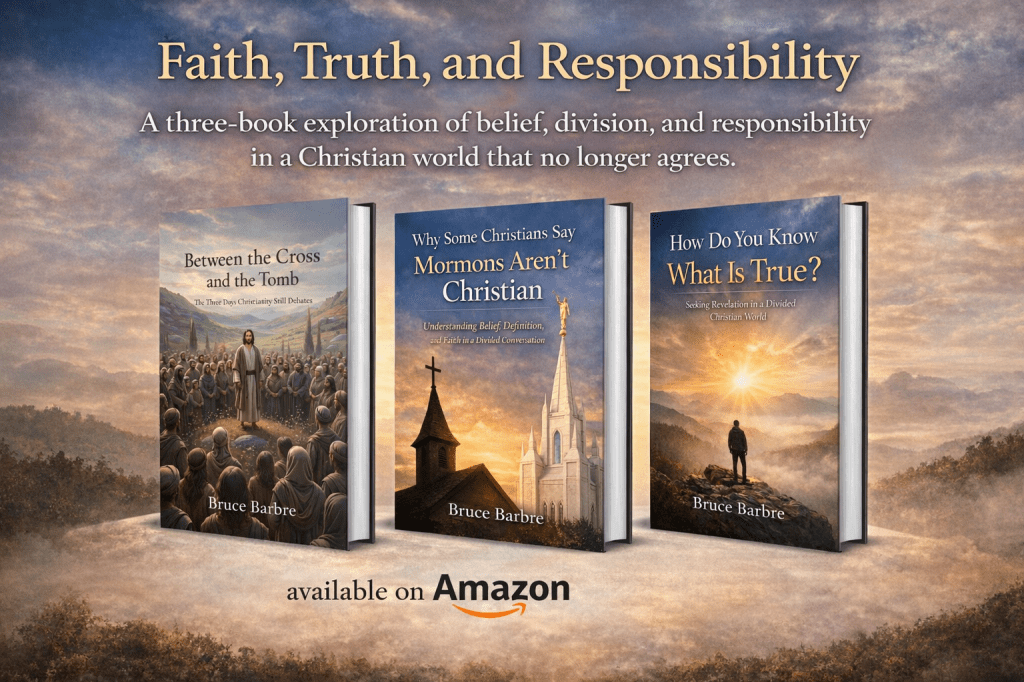
Over the past year, I completed a three-book series that explores this journey from different angles—belief, division, and personal responsibility. The series does not argue doctrine or defend a church. It invites reflection in a Christian world that no longer agrees.
The series is titled Faith, Truth, and Responsibility and is available on Amazon.
It is written for those who are not looking for answers to repeat, but for a way to live faith with integrity.
For a more meaningful, less noisy life in 2026.
 The Flameborne Path
Leave a comment